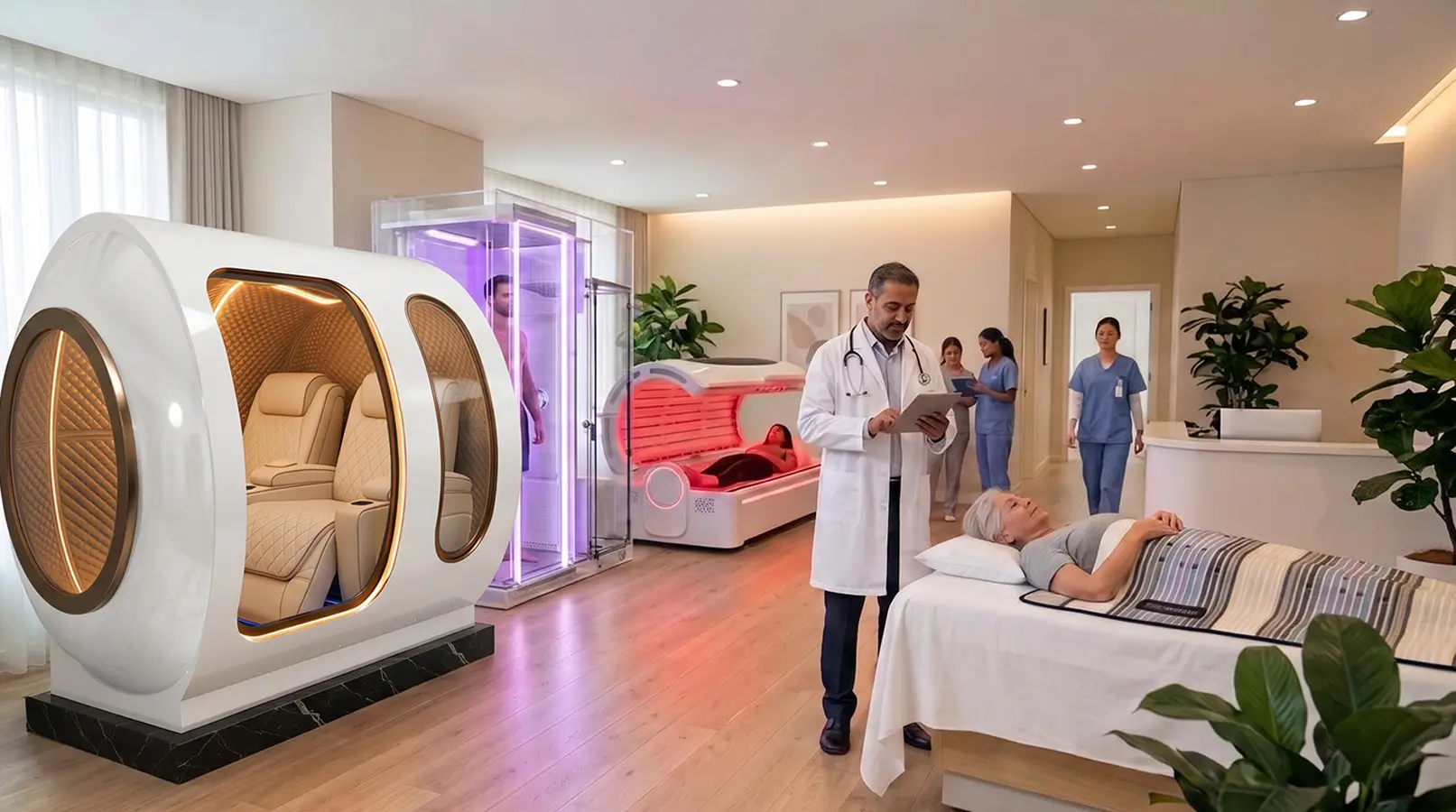
Wellness Center Equipment Selection That Scales
A premium wellness center is rarely limited by demand alone. It is more often limited by a room that cannot support the equipment, a session flow that requires too much staff involvement, or a feature set that looks impressive but does not improve the client experience. Effective wellness center equipment selection starts with the operating model: who will use the equipment, how often, in what room, and under whose supervision.
For a facility investing in hyperbaric chambers, cold recovery, red light, or PEMF, the objective is not to assemble the longest possible equipment list. It is to build a professional, repeatable service environment with appropriate capacity, refined comfort, reliable controls, and supportable ownership costs.
Start With the Service Model, Not the Product List
Before comparing chamber diameters, pressure ratings, or red-light output, define the experience the center intends to deliver. A performance facility serving athletes between training sessions has different throughput requirements than a private longevity studio offering scheduled, high-touch appointments. A hospitality property may prioritize visual design, quiet operation, and simple guest-facing controls. A membership-based recovery center may need durable equipment that performs consistently across a full day of bookings.
This distinction affects almost every equipment decision. A single-user system may be a strong fit for a compact studio with highly scheduled sessions. A two-person or walk-in configuration can support a more premium shared experience, accommodate a companion or staff assistance when appropriate, and help a larger facility avoid bottlenecks. More capacity is not automatically better, however. Larger equipment requires more floor space, more deliberate room planning, and a client volume that justifies the investment.
Map the client journey from arrival through checkout. Consider reception, changing areas, consultation space, session rooms, reset time, cleaning procedures, and how staff move between appointments. Equipment that is technically capable but awkwardly placed can slow the entire operation.
Wellness Center Equipment Selection: Capacity First
For commercial hyperbaric equipment, capacity has two meanings: the number of people who can use the chamber and the number of sessions the facility can deliver consistently. These are related, but they are not the same.
A single-person chamber can provide a private, focused experience and may allow a center to create several dedicated treatment rooms. A larger seated, upright, reclining, or walk-in chamber may be better suited to clients who value space, mobility, premium appointments, or multi-user sessions. The right configuration depends on whether the center is optimizing for privacy, comfort, accessibility considerations, group use, or appointment volume.
Pressure capability should be evaluated with the same discipline. Equipment operating at up to 2.0 ATA occupies a different category from lower-pressure systems in terms of vessel engineering, installation considerations, and buyer expectations. The best choice is not simply the highest pressure rating. It is the pressure capability that fits the facility's intended offering, training standards, room requirements, client comfort expectations, and long-term operating plan.
Also account for turnover. Ask how long a session lasts, how much time is required to prepare the room, and whether the equipment can be operated consistently by trained staff. A polished center protects the transition between clients. Rushed resets, difficult controls, and unclear operating procedures can undercut an otherwise premium service.
Treat the Room as Part of the Equipment Purchase
Capital equipment decisions should begin with a site review, not after the order is placed. A chamber may fit through a doorway yet still be poorly suited to the room once clearance, seating, oxygen equipment, ventilation, power access, and staff movement are considered.
Measure the complete delivery path: exterior access, parking or loading conditions, doorways, hallways, elevators, turns, and the final room. Then plan the installed environment. Ceiling height, finished floor loading, dedicated electrical circuits, ambient temperature, ventilation, network access for connected controls, and sound management can all affect the ownership experience.
Electrical requirements deserve particular attention. Recovery equipment may have different circuit needs depending on chamber systems, oxygen concentrators, climate control, powered recliners, red-light components, or cold recovery technology. A facility should confirm available power early with qualified local professionals rather than assuming an existing outlet is adequate.
Noise is equally practical. Oxygen concentrators, cooling components, pumps, and mechanical systems create operating sound. In a performance facility, that may be manageable. In a luxury spa suite, a quiet and composed room may be central to the value proposition. Equipment placement, room finishes, and separation from reception or consultation areas can make a meaningful difference.
Evaluate Comfort as an Operating Metric
Comfort is not decorative. It directly affects appointment quality, repeat use, staff workload, and the facility's ability to position a premium service.
Within hyperbaric equipment, buyers should look beyond the exterior footprint. Interior dimensions, seating or reclining position, entry and exit, climate control, lighting, communication, visibility, and control accessibility all shape the client experience. A client who feels confined, overheated, or uncertain about controls is less likely to view a session as refined, regardless of the chamber's technical specifications.
Features such as touchscreen interfaces, automated session controls, powered recliners, massage seating, integrated red light, and high-output oxygen delivery can be valuable when they support the actual service model. They should not be treated as isolated upgrades. For example, an automated control sequence may improve repeatability across multiple staff members, while climate control can be especially relevant in a facility running frequent sessions throughout the day.
The same principle applies across modalities. A whole-body cold recovery system should fit the center's changing, drying, and reset workflow. Red-light beds and full-body enclosures need sufficient clearance for access and cleaning. PEMF mats require a setting that feels intentional rather than improvised. Each modality should contribute to a coherent experience rather than create a collection of disconnected rooms.
Specify for Staff Usability and Consistency
A commercial wellness center should not depend on one highly experienced employee to operate its equipment correctly. Controls, training materials, operating procedures, and service access should support consistent use across shifts.
Look for clear touchscreen control, defined session settings, straightforward client communication, and systems that make routine operation easier to standardize. Equipment with overly complicated daily procedures can increase training time and create inconsistencies as the team grows.
Ask practical questions before purchase. Can staff observe and communicate with the client appropriately? How are session settings selected? What happens if a session needs to be paused? Which maintenance tasks can the team handle, and which require technical support? Are replacement parts and service resources accessible in the United States?
These questions are especially relevant for centers with extended hours, multiple locations, or a plan to add staff. Operational consistency is a brand asset. It protects the client experience while giving ownership a clearer view of labor requirements and equipment utilization.
Compare Ownership Value, Not Purchase Price Alone
The lowest initial quote can become the most expensive option if it produces service delays, uncomfortable sessions, limited capacity, or a premature need to upgrade. Conversely, a flagship configuration may not produce a better return if the facility lacks the room, demand, or staff structure to use its capabilities.
A useful comparison includes acquisition cost, delivery and installation planning, electrical work, consumables, maintenance, warranty terms, expected service access, staff training, and room build-out. For revenue-focused operators, also model appointment length, achievable sessions per day, membership utilization, and the role each modality will play in package design.
Serviceability should carry real weight. Wellness equipment is expected to operate repeatedly, often across long operating days. A manufacturer with U.S.-based technical support, clear warranty coverage, and practical installation resources can reduce uncertainty after delivery. OxyEdge supports this ownership approach with commercial-grade equipment, facility-planning guidance, training resources, and Tennessee-based customer and technical support.
Avoid framing wellness equipment as medical treatment. Hyperbaric chambers, red-light systems, cold recovery equipment, and PEMF products should be presented within a responsible wellness, recovery, and performance environment, not as products intended to diagnose, treat, cure, or prevent disease.
Build the Center in Phases When It Makes Sense
Not every facility needs to open with every modality. A phased plan can preserve capital while allowing the center to validate demand, refine its workflow, and expand with purpose. The first equipment purchase should establish a standard for presentation, operating quality, and client comfort that future additions can match.
Start with the services that fit the facility's strongest demand and physical constraints. Leave room in the layout, electrical plan, and business model for the next equipment category. That approach is often more disciplined than filling every available square foot at launch.
The right equipment should make the center feel easier to operate six months after opening, not more complicated. Select systems your staff can run with confidence, your clients will want to return to, and your facility can support properly from delivery through long-term service.
Source: https://oxyedge.ai/wellness-center-equipment-selection