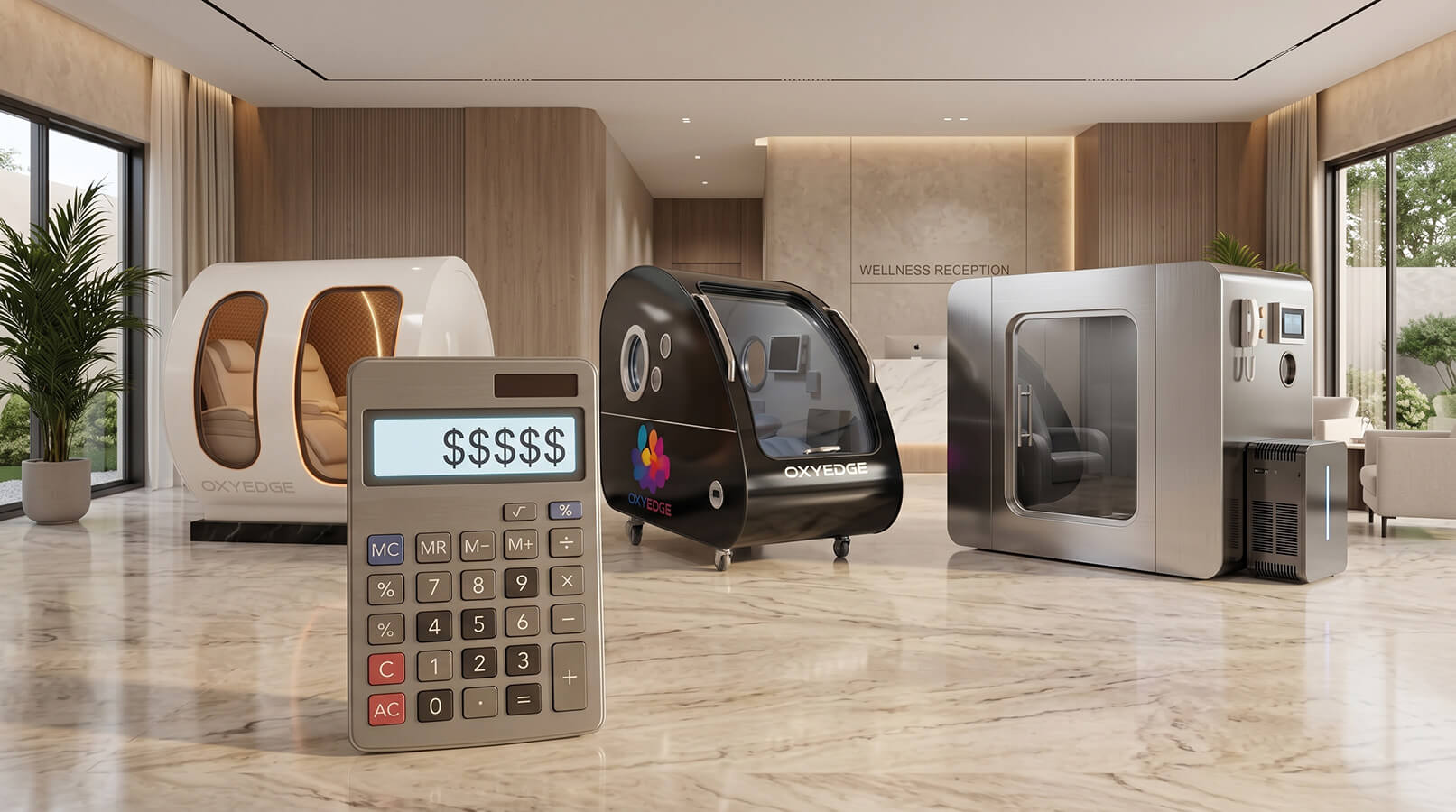
Hyperbaric Chamber ROI Calculator for Centers
A premium chamber can look like a compelling revenue asset on a showroom floor, but its economics are decided by the calendar. A hyperbaric chamber ROI calculator gives wellness-center operators a disciplined way to test whether scheduled sessions, membership usage, staffing, and financing can support the investment before equipment is ordered.
For a recovery studio, athletic-performance facility, luxury gym, or hospitality property, the right question is not simply, "How much can we charge per session?" It is whether the chamber will produce enough contribution margin after labor, occupancy, operating costs, and capital costs to justify the floor space and management attention it requires.
Start With Revenue Capacity, Not a Session Price
Session price is visible. Available appointment capacity is the harder variable, and it has more influence on return on investment. A chamber that operates for 10 hours per day is not automatically capable of selling 10 hours of sessions. Operators need to account for session duration, customer turnover, pre-session orientation, cleaning, pressure-cycle timing, booking gaps, and staff availability.
Begin with a realistic session block. If a customer experience occupies 75 minutes from check-in to room reset, eight session blocks may fit into a 10-hour operating day. That is theoretical daily capacity. Then apply a utilization assumption: the percentage of those available blocks that are actually used by paying customers or valid membership redemptions.
A practical starting model might look like this:
- Eight available session blocks per day
- 26 operating days per month
- 35% utilization during launch
- $125 average realized revenue per session
This produces 73 booked sessions per month and $9,125 in monthly gross revenue. The phrase "realized revenue" matters. If the published price is $150 but packages, memberships, introductory offers, and partner discounts reduce the average collected amount to $125, $125 is the figure the calculator should use.
A flagship chamber with a two-person, walk-in, seated, or reclined configuration may change the equation. Multi-user capacity can increase revenue per pressure cycle, but only if the operator can consistently sell paired appointments, accommodate guests comfortably, and preserve a premium experience. Do not assume every seat will be occupied simply because the chamber has room for more than one person.
Build Your Hyperbaric Chamber ROI Calculator Around Contribution Margin
Gross revenue does not pay back a capital investment. Contribution margin does. Your hyperbaric chamber ROI calculator should subtract every incremental monthly cost required to deliver sessions at the expected service level.
Start with direct labor. A highly automated chamber with touchscreen control can simplify operation, but a polished commercial experience still involves staff time for customer orientation, booking management, room preparation, sanitation, and session oversight. Estimate labor by minutes per appointment, not by a vague monthly staffing allowance.
Next, include consumables, cleaning materials, utilities, routine service allowances, software or booking costs if applicable, insurance changes, merchant fees, and marketing costs specifically tied to chamber bookings. If the equipment is financed, include the actual monthly payment. If it is purchased outright, model a monthly capital-recovery target so the analysis remains comparable.
For example, assume the $9,125 monthly gross revenue model above has $2,000 in incremental labor, $450 in operating and cleaning costs, $275 in payment-processing and promotion expense, and a $2,300 equipment finance payment. The monthly cash contribution is $4,100 before general overhead and taxes.
That number is more useful than revenue because it shows the chamber's ability to pay for itself. It also gives operators a clear threshold: how many sessions are required each month before the chamber covers its dedicated costs?
Calculate Break-Even Sessions
Break-even sessions are one of the most actionable outputs in any equipment model. Use this formula:
Monthly fixed costs ÷ contribution per session = break-even sessions per month
Contribution per session equals average realized revenue minus variable per-session costs. If your average session produces $125 in revenue and carries $18 in variable labor, cleaning, and transaction costs, the contribution per session is $107.
If monthly fixed costs, including finance payment and allocated marketing, total $3,000, the break-even point is about 29 sessions per month. At 26 operating days, that is just over one paid session per day. This is a useful stress test because it turns a large purchase decision into an operational target your team can manage.
Be careful not to hide fixed costs inside overly optimistic averages. A dedicated chamber room has an opportunity cost. If that room could support another profitable service, the model should reflect that alternative. For a luxury facility, the chamber may also support retention, membership differentiation, and premium positioning. Those benefits can be real, but they should be counted separately from direct chamber-session revenue rather than used to disguise weak utilization.
Model Three Utilization Scenarios
A single ROI forecast creates false confidence. Strong operators build a conservative case, a base case, and an upside case. The purpose is not to manufacture an impressive payback period. It is to understand what must be true for the investment to perform.
In a conservative launch case, a new studio might operate at 20% utilization while local awareness and staff confidence develop. A base case may assume 35% to 45% utilization after the service is established. An upside case may reflect 60% utilization, a strong membership base, and a refined sales process. The appropriate assumptions depend on local demand, hours of operation, chamber configuration, and how prominently the service appears in your customer journey.
Use the same price and cost logic in every scenario. Change utilization, average realized revenue, and perhaps labor efficiency only when there is a credible reason to do so. This makes sensitivity visible. If your return disappears when utilization moves from 40% to 30%, the project may still work, but it needs a stronger pre-sale, membership, or partnership plan before deployment.
Account for the Equipment Configuration
Not every mild hyperbaric chamber should be evaluated with the same calculator inputs. A compact single-person chamber may be appropriate for a private home, a tightly programmed recovery studio, or a facility testing demand with limited floor space. Its lower acquisition cost can shorten payback, though its throughput is naturally constrained.
A commercial-grade hard-shell chamber designed for frequent use may carry a higher capital cost, but it can support a more polished customer experience, sustained operation, and a premium service environment. Features such as climate control, high-output oxygen concentrators, electric seating, integrated red light, touchscreen interfaces, and a pressure vessel rated up to 2.0 ATA can affect customer comfort, staff workflow, and perceived service value. They do not automatically justify a higher price. The operating model must justify it.
For wellness centers, reliability and downtime deserve a line item as well. A lower-priced asset that creates scheduling disruption, inconsistent customer comfort, or difficult service coordination can cost more over time than its initial quote suggests. Evaluate warranty coverage, training, installation requirements, technical support, replacement-part access, and the supplier's ability to support commercial operators in the United States.
Treat Membership Revenue Carefully
Memberships can stabilize utilization, but they can also obscure profitability. If chamber sessions are included in a broad membership, assign a realistic internal value to each redemption. Otherwise, a fully booked chamber can appear to generate no revenue, or worse, it can consume capacity that could have been sold at a higher margin.
A better approach is to define monthly chamber access, booking limits, upgrade pricing, and peak-hour rules. For example, an operator may include one session per month in a premium membership and charge a preferred member rate for additional bookings. This gives members a meaningful benefit while preserving capacity for paid sessions and guests.
Track redemption behavior after launch. If members use fewer sessions than forecast, the program may have more margin than expected. If demand clusters in evenings and weekends, consider peak pricing or member booking windows rather than adding equipment prematurely.
Do Not Turn Wellness Economics Into Medical Claims
A chamber revenue forecast should be built around the quality of the wellness experience, not claims about diagnosing, treating, curing, or preventing disease. Mild hyperbaric chambers in non-medical settings should be presented responsibly as wellness equipment. Staff education, customer communications, and sales materials need to stay within that boundary.
That discipline is also good business. A premium operator does not need exaggerated promises to sell a well-designed recovery environment. Clear orientation, comfort, privacy, consistent session protocols, and professional presentation can create an experience customers value and return to use.
Use the Calculator Before You Select the Chamber
The calculator should influence the purchase, not merely justify it afterward. Run the model for each configuration under consideration. Compare acquisition cost, available seats, room requirements, target price, anticipated utilization, and service workflow. If financing is part of the plan, test several term lengths and down-payment levels instead of accepting the first payment estimate.
OxyEdge operators can also use this process to identify the chamber category that matches their business model rather than choosing strictly by initial price. A luxury hospitality property may prioritize guest experience and private scheduling. A performance facility may need throughput and repeatable staff workflows. A home buyer may value long-term ownership, comfort, and simplicity more than direct session revenue.
The most useful outcome is not an optimistic payback number. It is a launch plan with a break-even target, a realistic ramp period, a clear pricing structure, and an operating standard your staff can deliver every day.
Source: https://oxyedge.ai/hyperbaric-chamber-roi-calculator