Chamber Pressure Explained for Serious Buyers
A chamber rated at 2.0 ATA is not simply “more powerful” than one rated at 1.5 ATA. It is built to operate at a meaningfully higher absolute pressure, which affects the pressure vessel, operating systems, user experience, oxygen-delivery planning, and the type of buyer it may suit. This guide provides chamber pressure explained in practical terms for private owners and professional wellness operators evaluating premium hyperbaric equipment.
What Chamber Pressure Means
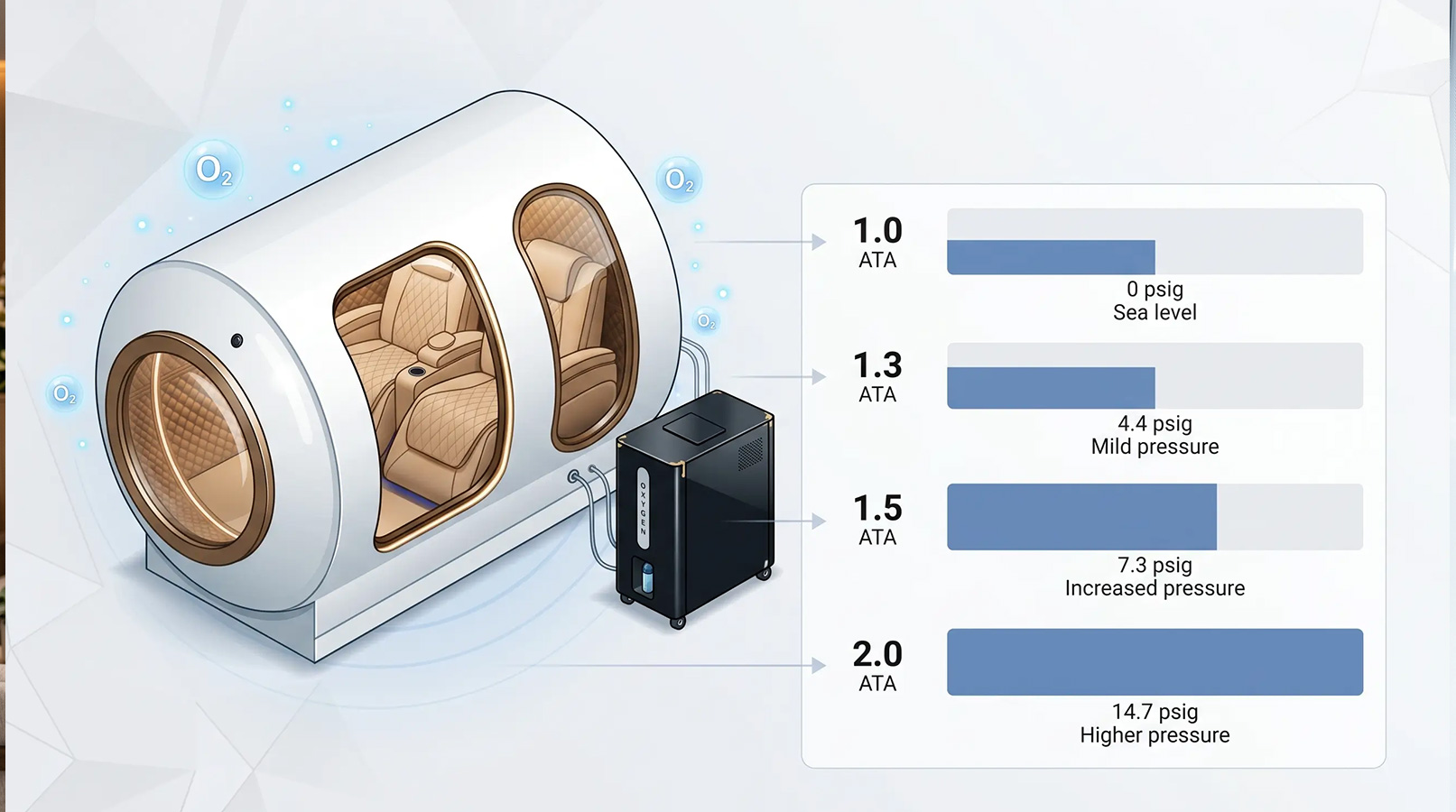
Chamber pressure describes the air pressure inside the chamber compared with normal atmospheric pressure outside it. The industry commonly expresses this measurement in ATA, or atmospheres absolute.
At sea level, the air around us is approximately 1.0 ATA. A chamber operating at 1.5 ATA reaches one and a half times normal atmospheric pressure. A chamber operating at 2.0 ATA reaches twice normal atmospheric pressure.
The word absolute matters. ATA includes the atmosphere already present outside the chamber. A 1.5 ATA operating pressure means the chamber is pressurized by an additional 0.5 ATA above ambient conditions. A 2.0 ATA chamber adds 1.0 ATA above ambient pressure.
This is different from gauge pressure, a measurement that starts at zero at ambient conditions. Buyers may see both terms in technical discussions, but ATA is the clearer standard for comparing hyperbaric chamber operating capability.
Chamber Pressure Explained at 1.5 vs. 2.0 ATA
The practical difference between 1.5 ATA and 2.0 ATA is substantial. A 2.0 ATA system does not merely add a small increment of pressure. It doubles the absolute atmospheric pressure inside the chamber relative to the environment outside.
Higher-pressure capability requires a pressure vessel and supporting systems engineered for that operating range. The chamber structure, seals, valves, compressors, controls, safety systems, and manufacturing standards all play a role in sustained operation. This is why buyers should look beyond a single pressure number and assess the equipment as a complete engineered system.
A 1.5 ATA chamber may be appropriate for buyers who prioritize a compact footprint, lower infrastructure demands, and a straightforward home wellness setup. A 2.0 ATA chamber can be a better fit for buyers who place a premium on higher operating pressure, commercial-grade construction, expanded control capability, or frequent use in a professional setting.
Neither rating is automatically right for every installation. The best choice depends on intended use, chamber configuration, available room, electrical service, budget, expected session volume, and comfort expectations.
Pressure Is Only One Part of Oxygen Exposure
Pressure and oxygen delivery are related, but they are not the same specification. Chamber pressure refers to the pressurized environment. Oxygen delivery refers to how oxygen is supplied to the user, often through a concentrator and personal interface.
A quality oxygen system should be evaluated by its output capacity, operating consistency, compatibility with the chamber, and ability to support the intended number of occupants. For a single-user chamber, the oxygen-delivery requirement differs from a multi-user walk-in installation serving several clients across a business day.
This distinction is particularly important when comparing equipment. A chamber can have an attractive ATA rating, but a buyer should also ask about concentrator capacity, oxygen interface configuration, maintenance requirements, and how the system is designed to perform during repeated sessions.
OxyEdge equipment is positioned as wellness equipment, not as a device intended to diagnose, treat, cure, or prevent disease. Buyers should evaluate pressure and oxygen specifications as equipment-performance considerations and consult qualified professionals regarding any personal health questions.
Why Higher Pressure Changes the Equipment
Pressure creates force across every part of a chamber enclosure. As operating pressure increases, the chamber must be designed to manage that force reliably over time. This is one reason a true higher-pressure system requires more than a larger compressor or a different setting on a control panel.
Rigid chambers use a defined pressure vessel structure, typically with engineered doors, viewing surfaces, seals, plumbing, and pressure-management components. Their construction can support refined interior layouts, including reclining seating, upright seating, climate control, touchscreen interfaces, automated session controls, and integrated wellness features.
For home buyers, this can translate into a more comfortable and polished ownership experience. For commercial operators, it can support a professional presentation, predictable staff workflows, and equipment capable of frequent client use.
The trade-off is that higher-capability equipment generally requires more planning. Buyers should expect to discuss delivery access, installation location, electrical needs, ventilation, room clearance, flooring, service access, and operating procedures before purchase.
Comfort at Pressure: What the User Actually Feels
The most noticeable part of a session is often the pressure change during compression and decompression. As chamber pressure rises, users may feel fullness or pressure in the ears, similar to an aircraft descent or ascent. Equalization techniques, performed according to operating guidance, help manage this normal sensation.
A well-designed system gives the user and operator control over the experience. Compression rate, communication capability, cabin temperature, seating position, interior space, and controls all affect comfort. A spacious seated or reclining chamber may feel considerably different from a compact single-person configuration, even when both operate at the same ATA rating.
For a first-time home buyer, comfort may be the factor that determines whether the equipment becomes part of a consistent routine. For a facility, it affects client satisfaction, staff intervention, and repeatable session delivery. A premium chamber should be evaluated from the inside as carefully as it is evaluated on a specification sheet.
Selecting Pressure for a Home Installation
A home installation begins with practical questions rather than pressure alone. How much room is available? Will the chamber be used by one person or shared by a couple or family? Is seated access preferable to a reclining layout? Can the equipment be delivered through the planned entry route? What electrical service is available in the room?
A compact system may make sense where space is limited and the priority is personal use. A larger two-person, upright, or reclining chamber can be a stronger long-term choice when comfort, shared use, and a more refined room presence matter.
Pressure capability should align with the broader ownership plan. It is reasonable to compare 1.5 ATA and 2.0 ATA, but the decision should also account for construction quality, control system design, oxygen capacity, noise, climate management, warranty terms, and access to technical support. Equipment that fits the room but fails to fit the ownership experience is not a strong investment.
Selecting Pressure for Commercial Operations
Commercial operators need to consider pressure alongside throughput and operational consistency. A higher-end chamber can become a visible centerpiece of a recovery studio, wellness center, private club, or athletic-performance facility. Yet the best system is the one that staff can operate confidently, clients can use comfortably, and the business can support over the long term.
A multi-user or walk-in layout may improve capacity, while individual chambers can support private appointments and more flexible scheduling. Seating configuration affects not only comfort but also how easily clients enter, exit, and settle into a session. Touchscreen controls and automated session programming can reduce avoidable variability in daily operations.
The facility should also plan for staff training, cleaning procedures, maintenance intervals, oxygen-system management, client screening protocols, and escalation processes. Commercial-grade equipment value is measured over years of dependable operation, not only on delivery day.
Pressure Ratings Should Be Verified, Not Assumed
When comparing chamber options, ask direct questions. What is the maximum operating pressure in ATA? Is that pressure intended for sustained operation? What type of pressure vessel is used? How is pressure monitored and controlled? What oxygen equipment is included? What service, warranty, training, and installation resources are available?
Also confirm what is included in the quoted configuration. A chamber, oxygen concentrator, communication system, climate-control package, and automated controls may be presented differently across manufacturers. Clear specifications prevent an apparently lower-cost option from becoming a more expensive project after delivery.
For serious buyers, the strongest purchase decision combines pressure capability with construction, comfort, operational planning, and accountable support. The right chamber is not defined by its ATA rating alone. It is defined by how confidently that rating is delivered, controlled, supported, and integrated into the place where people will actually use it.
Before selecting a chamber, map the installation and operating plan with the same care used to compare pressure ratings. That approach turns a technical specification into an equipment decision built for reliable long-term ownership.