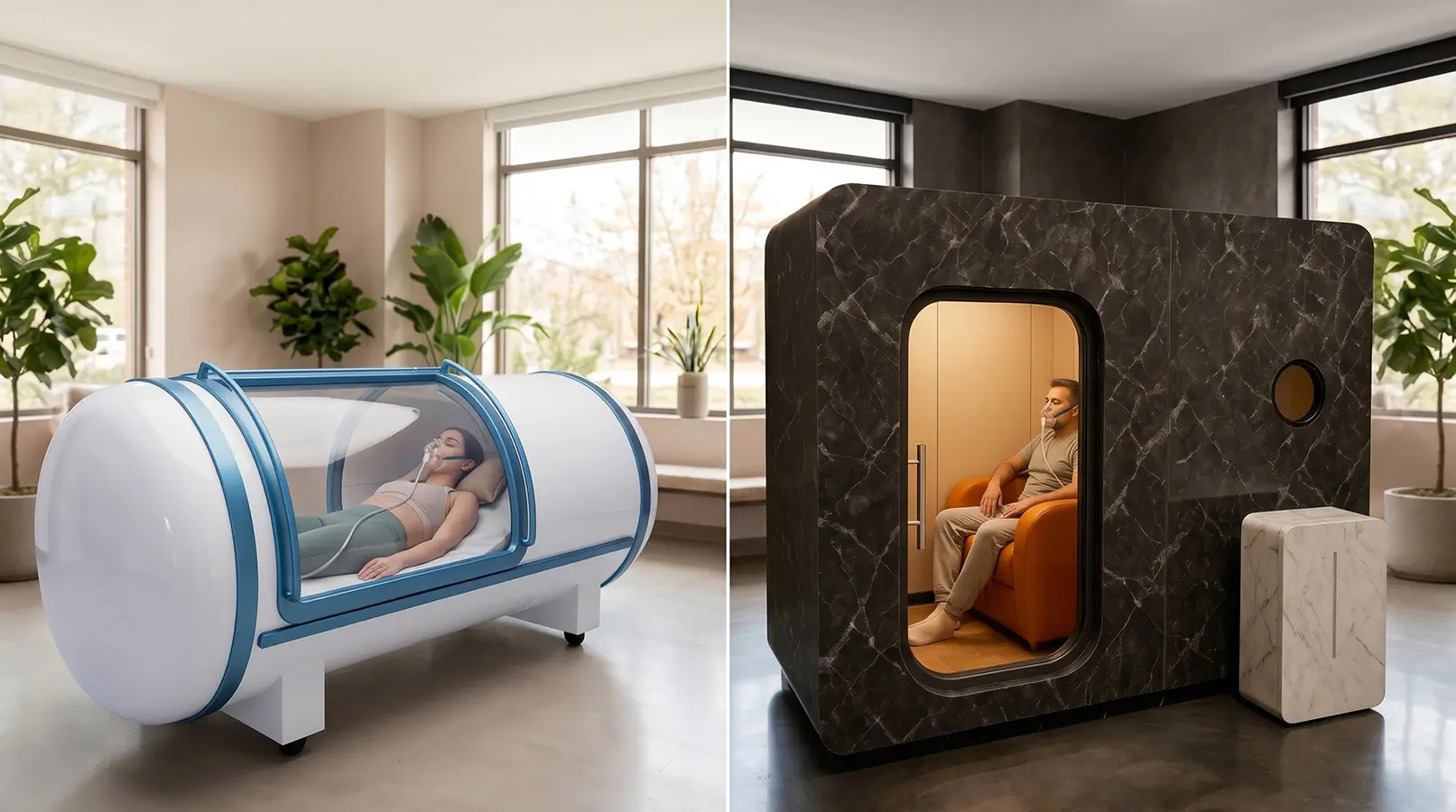
Vertical Versus Horizontal Hyperbaric Chambers
A chamber can look exceptional in a showroom and still be the wrong fit for the room, user, or operating model. The real decision in vertical versus horizontal hyperbaric chambers is not simply whether a person sits or reclines. It affects room planning, entry and exit, perceived spaciousness, comfort over repeated sessions, staff workflow, and the kind of experience a home owner or commercial client remembers.
Both formats can be refined, high-performance wellness equipment. Neither orientation is inherently better. The right choice depends on how the chamber will be used, who will use it, and what the installation environment can realistically support.
Vertical Versus Horizontal Hyperbaric Chambers: What Changes
A vertical chamber generally places the user in a seated, upright, or semi-upright position. Its pressure vessel is taller and typically occupies a more compact floor footprint than a reclining model. This design can work especially well where floor area is limited but ceiling height is available.
A horizontal chamber is designed around a reclined or fully reclining user position. It requires more length in the room, yet it often creates a familiar, low-effort session environment. For users who prefer to rest, read, listen to audio, or settle into a long recovery routine, that comfort difference can be decisive.
The orientation alone does not determine operating pressure, oxygen delivery capacity, build quality, or control sophistication. A buyer should not assume that upright means entry-level or that horizontal means more capable. Commercial-grade chambers in either configuration can be engineered for sustained operation, intuitive touchscreen control, climate management, and premium interior finishes. Review the actual pressure rating, construction, oxygen system, included equipment, and support plan rather than treating shape as a shortcut for performance.
Comfort Is More Than the Seat
For many first-time buyers, reclining sounds automatically more comfortable. Often, it is. A horizontal chamber allows the body to rest naturally and can feel less demanding during longer sessions. That matters for home users who want a quiet, repeatable part of a recovery or wellness routine, as well as for commercial facilities serving clients after training or travel.
Still, upright comfort has legitimate advantages. Some people dislike lying flat, have difficulty getting down to a low entry height, or prefer to sit while using a tablet, working, or speaking with staff outside the chamber. A well-designed seated chamber with adequate internal width, supportive seating, climate control, and easy-to-reach controls can feel notably more open than its exterior dimensions suggest.
For couples and families, consider the actual user mix rather than the most frequent user alone. An athletic adult may be comfortable in a compact reclined chamber, while an older family member may find a seated entry and upright posture easier. In a commercial setting, a mixed clientele often favors an accessible configuration that does not require staff to assist clients in and out of a reclined position.
Comfort also depends on heat, sound, lighting, and session control. Chamber orientation does not solve those details. Ask how the unit manages interior temperature, where the oxygen delivery components are located, how clearly users can communicate during a session, and whether the controls can be operated easily from inside and outside the vessel.
Room Footprint and Installation Planning
A vertical chamber trades floor length for height. That can be a major advantage in a home gym, executive office, recovery room, or commercial suite where every square foot matters. But a compact footprint should never be evaluated without the ceiling requirement. The chamber itself may fit under the ceiling while leaving insufficient clearance for installation, access panels, ventilation planning, or service work.
A horizontal chamber requires more open floor length, including practical space around the entry door and enough room for a user or staff member to move safely. It may be easier to position in a long wall layout, dedicated wellness room, or larger commercial recovery area. Its lower profile can be more compatible with standard ceiling heights, depending on the model.
The room must accommodate more than the pressure vessel. A complete plan accounts for electrical service, oxygen equipment placement, ventilation, climate conditions, delivery path from the curb to the final room, doorway widths, flooring, and usable clearance. Buyers should also plan for technician access over the life of the equipment. A chamber that can be installed but cannot be conveniently serviced is not a well-planned installation.
For commercial operators, positioning affects presentation as much as logistics. The chamber should feel intentional within the client journey, not inserted into leftover space beside storage or mechanical equipment. A premium room with clean sightlines, appropriate lighting, controlled sound, and a clear check-in process supports confidence before the session begins.
Entry, Exit, and Daily Usability
Door design and entry height are often more relevant than overall chamber dimensions. Vertical configurations may make it easier for users to step in and sit down, particularly when compared with a low reclining platform. They can be a practical choice for facilities seeking a straightforward staff handoff: client enters, sits, receives orientation, and begins a programmed session.
Horizontal configurations ask the user to transition into a reclined position. For many people this is simple and comfortable, but it deserves consideration when serving clients with limited mobility, stiffness after intense training, or a preference for seated access. Facilities should establish clear screening and assistance procedures appropriate to their equipment and clientele.
For home ownership, think about the least convenient day, not just the first session. Will the primary user be able to enter and exit comfortably without assistance? Can controls be reached without awkward movement? Is there room for a spouse, family member, or support person to stand nearby if needed? These questions turn a visually appealing installation into equipment that gets used consistently.
Capacity and Commercial Session Flow
A larger horizontal layout can be attractive for users who want room to recline, while a multi-user upright or walk-in configuration may better support a facility focused on capacity. Neither model automatically produces higher throughput. Throughput depends on session duration, turnover procedures, staffing, cleaning protocol, booking cadence, and how consistently the equipment is operated.
A commercial operator should compare the total experience per appointment. If a reclining chamber delivers a premium private session that supports a higher-priced service, its larger footprint may be justified. If the business model depends on efficient repeat visits, easy client movement, and staff visibility, an upright chamber may be the stronger operational fit.
Controls matter here. Automated session controls and touchscreen interfaces can help standardize routine operation, reduce avoidable staff variation, and create a more polished handoff between appointments. They do not replace training. Staff should understand the chamber, operating procedures, communication methods, safety guidance, cleaning requirements, and escalation process before the first client is scheduled.
Pressure and Oxygen Delivery Should Be Evaluated Separately
Orientation is only one part of chamber selection. Pressure capability is another. A buyer comparing 1.5 ATA and 2.0 ATA equipment should evaluate the operating range, vessel engineering, intended use environment, and the practical ownership requirements associated with the system. Higher pressure capability should be considered alongside chamber construction, controls, compressor performance, oxygen supply capacity, heat management, and manufacturer support.
Oxygen delivery also warrants a specific conversation. High-output oxygen concentrators, tubing configuration, mask or cannula approach, maintenance intervals, and installation layout influence the daily user experience. These systems require disciplined operating procedures and should be used according to the manufacturer’s instructions and applicable safety guidance.
Hyperbaric wellness equipment is not a device intended to diagnose, treat, cure, or prevent disease. Serious buyers should be cautious of broad health promises and instead focus on equipment specifications, comfort, operational consistency, and a responsible ownership plan.
Choosing the Right Configuration
Choose a vertical or seated chamber when floor space is limited, users value upright access, the room has suitable ceiling clearance, or a facility benefits from a compact, professional session format. It can be an especially practical answer for offices, studios, and homes where a full-length reclining vessel would dominate the room.
Choose a horizontal or reclining chamber when deep physical relaxation is central to the experience, users strongly prefer a lying position, and the room can support the required length and working clearance. It often suits dedicated home wellness rooms, recovery suites, and premium client environments designed around a slower, more private session.
The best decision begins with a scaled room plan, a realistic user profile, and a clear ownership model. OxyEdge buyers should expect to discuss dimensions, ceiling height, electrical requirements, oxygen configuration, delivery access, operating pressure, warranty coverage, and long-term service before selecting a chamber. The chamber that earns its place is the one that fits the room, supports the user, and can be operated confidently for years.
Source: https://oxyedge.ai/vertical-versus-horizontal-hyperbaric-chambers