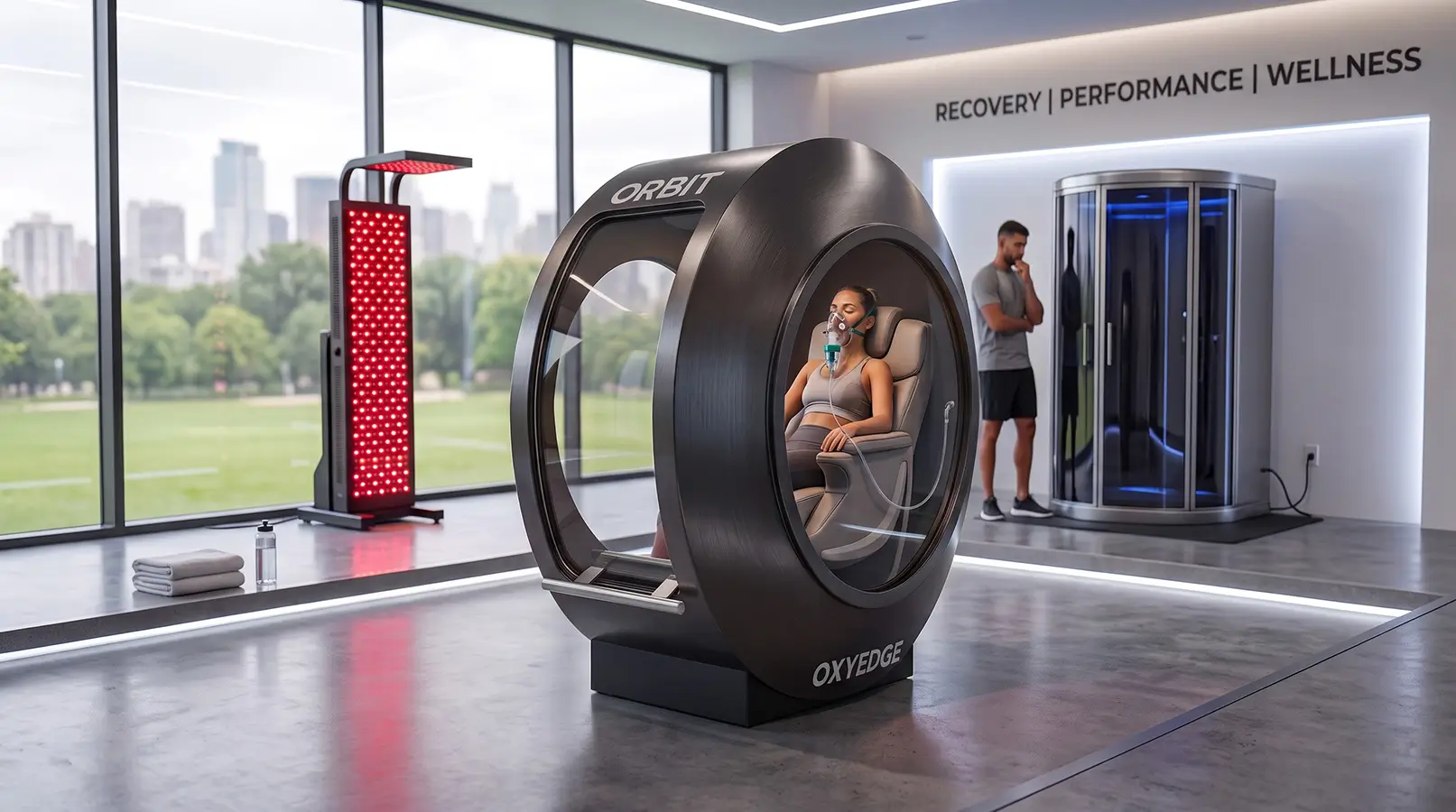
Recovery Equipment That Performs Under Pressure
A premium recovery room can lose its value quickly when the equipment looks impressive on opening day but proves difficult to schedule, clean, explain, or maintain six months later. Recovery equipment is not simply a collection of wellness features. For a serious operator, it is an operating system for a repeatable guest experience, staff workflow, and long-term capital investment.
The right mix depends on the business model. A private residence may prioritize quiet operation, comfort, and simple controls. A performance facility may need fast turnover and equipment that withstands sustained use. A luxury wellness center must deliver both: polished presentation for the client and practical reliability for the team behind the desk.
What Premium Recovery Equipment Must Deliver
The category has expanded well beyond a single modality. Mild hyperbaric chambers, whole-body cold wellness systems, red-light beds and enclosures, and PEMF wellness mats can each play a useful role in a premium recovery menu. Buying them as isolated products, however, often creates operational friction.
A well-planned equipment program should give members and guests a clear reason to book, employees a consistent way to run sessions, and owners a path to utilize the room throughout the day. That calls for more than a feature checklist. It requires matching equipment capacity, physical footprint, session duration, electrical needs, controls, client comfort, service access, and support coverage to the real conditions of the facility.
For many operators, the question is not whether a modality is popular. It is whether it can be delivered consistently at a standard that supports a premium price point.
Durability is an operational feature
Commercial-grade construction matters because recovery rooms are rarely used like private living rooms. Doors, seals, seating, control interfaces, flooring, and climate systems see repeated interaction from clients and staff. A system designed for occasional use can become a bottleneck when bookings stack up or when multiple team members need to operate it.
Look closely at the components that influence daily uptime. In a hard-shell mild hyperbaric chamber, that includes the pressure vessel, door hardware, oxygen concentrator output, air management, climate control, controls, and internal materials. In cold, red-light, and PEMF systems, it includes the treatment surface, enclosure integrity, control electronics, sanitation requirements, and access for service.
Durability is not only about avoiding failure. It protects the consistency of the experience your business is selling.
Comfort directly affects utilization
Clients do not evaluate a session only by the modality. They remember the temperature, noise level, sense of space, seating position, lighting, and how confidently the process was explained. A cramped chamber or a complicated cold system may technically fit the floor plan while limiting the number of people willing to use it regularly.
This is why configuration deserves as much attention as specifications. Single-person chambers can be an efficient fit for private owners and focused appointment models. Two-person, walk-in, seated, vertical, or reclined configurations may better support companion sessions, staff-assisted clients, or a hospitality-forward environment. Electric recliners, massage seating, integrated red light, and climate control may not be required in every facility, but they can materially change the perceived value of a premium session.
The trade-off is straightforward: larger and more feature-rich equipment generally requires more space, a larger investment, and more deliberate traffic flow. The best choice is the one that aligns comfort with the number of sessions you can realistically deliver.
How to Build a Recovery Equipment Strategy
Start with the service model before comparing products. A facility offering recovery as an included gym amenity has different needs than a boutique studio selling 60-minute appointments or a hotel creating a private wellness suite. Equipment should support the service architecture, not force the business into a format that does not fit its clientele.
Define the session menu and throughput
Map the client journey from check-in through post-session turnover. Determine whether clients will self-book, whether staff will remain nearby, how long orientation takes, and how sanitation fits between appointments. A premium room with a 45-minute session can be profitable, but only if the schedule includes realistic time for transitions rather than assuming every hour is fully sellable.
Then examine throughput modality by modality. A multi-user system may generate more capacity, yet it may require more coordination and a larger room. A single-user system may offer stronger privacy and simpler scheduling while limiting peak-hour volume. Neither approach is automatically superior.
Operators should also consider whether modalities will be sold individually, packaged into recovery circuits, offered through memberships, or positioned as a high-value add-on. A multi-modality room can increase average revenue per visit when the experience is designed with intention. It can also become confusing if every service is described as interchangeable.
Specify the room before placing an order
Recovery equipment decisions often fail at the facility-planning stage, not the product stage. Measure clear access paths, doorways, ceiling height, usable floor area, and the room needed for staff movement and service. Confirm electrical requirements, ventilation considerations, flooring, drainage where applicable, climate conditions, and delivery access before finalizing a configuration.
For mild hyperbaric chambers, pressure rating is only one part of the evaluation. Operators should understand the difference between soft-sided and hard-shell construction, the intended operating pressure, oxygen supply approach, interior controls, communication features, climate management, and emergency procedures. A hard-shell chamber rated up to 2.0 ATA can offer a more substantial commercial platform, but the right model still depends on use case, occupancy, site conditions, and the operator's ability to manage the experience responsibly.
Ask suppliers for clear dimensions, site-preparation requirements, shipping coordination details, installation resources, and support expectations. If answers are vague before purchase, they are unlikely to become clearer after delivery.
Controls, Training, and Safety Education Matter
Luxury equipment should feel simple to the client without hiding critical controls from the operator. Touchscreen interfaces, programmable settings, and centralized platforms can reduce staff variability, especially in businesses with multiple shifts. The goal is not to remove staff judgment. It is to give trained personnel a reliable framework for delivering sessions.
OxyEdge OS™, for example, is designed around chamber control and operational usability rather than adding technology for its own sake. That distinction matters in a commercial setting, where a clean interface can reduce onboarding time and help staff follow established procedures.
Training should cover normal operation, client orientation, sanitation, documentation, routine checks, escalation procedures, and the limits of the equipment's intended use. These systems belong in non-medical wellness environments unless the facility has the appropriate medical infrastructure and oversight. Mild hyperbaric wellness equipment is not intended to diagnose, treat, cure, or prevent disease, and sales language should remain disciplined accordingly.
A credible supplier will be direct about both capability and responsibility. Marketing claims that promise medical outcomes may create unnecessary risk for an operator and distract from the actual value proposition: a controlled, premium wellness experience.
Evaluate Total Ownership, Not the Purchase Price
Initial price is visible. Downtime, support gaps, and poorly planned installation are not always visible until they become expensive. When evaluating recovery equipment, include delivery, placement, site readiness, training, warranty terms, consumables, maintenance expectations, replacement parts, and technical support in the ownership calculation.
For wellness-center owners, business-development support can also matter. New operators may need assistance with service positioning, staff education, launch planning, and financial modeling. Sophisticated buyers may need less guidance, but they still benefit from a supplier that understands commercial scheduling, member expectations, and the consequences of equipment downtime.
Warranty language deserves particular attention. Ask what is covered, for how long, who performs service, how technical issues are triaged, and whether U.S.-based support is available. A long warranty has limited value if response times are unclear or replacement components are difficult to source.
A Better Standard for the Recovery Room
The strongest recovery spaces do not feel like showrooms crowded with disconnected trends. They feel intentional. Every system has a place in the client journey, every staff member understands the workflow, and the room communicates quality before a session begins.
Choose equipment that can carry that standard after the novelty fades. When construction, controls, comfort, support, and service design work together, recovery becomes more than an amenity. It becomes a reason for clients to return and a durable asset your operation can build around.
Source: https://oxyedge.ai/recovery-equipment-that-performs-under-pressure